
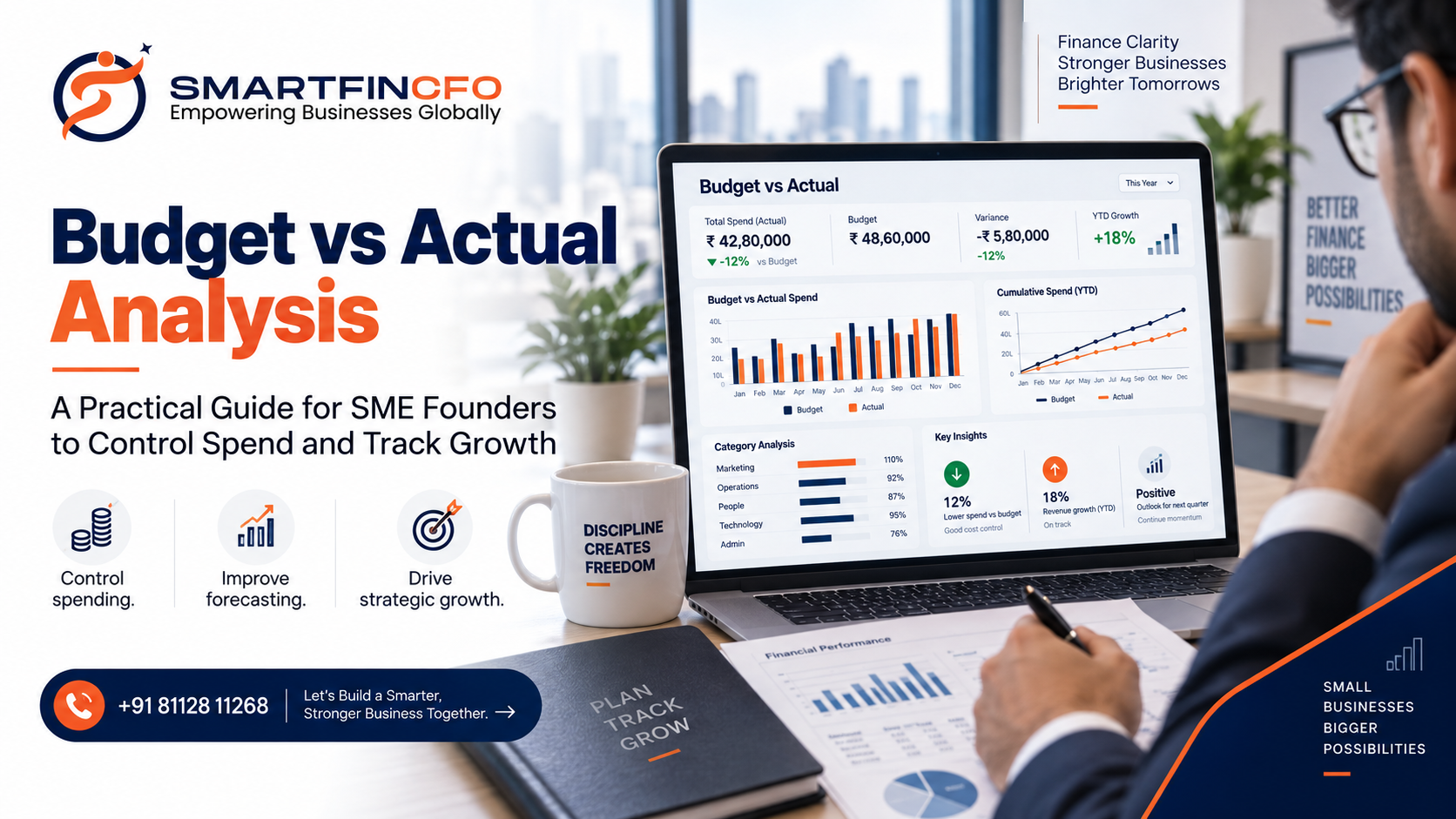
As a founder, you know the original plan. You mapped out ambitious revenue targets, allocated quarterly marketing budgets, and factored in headcount expansion. But when month-end arrives, the numbers reflected on your profit and loss statement often tell a different story. Marketing campaigns overshot projections by 30%, software subscriptions quietly crept upward, and a critical client project delivered less gross margin than expected.
This discrepancy between your strategic blueprint and operational reality is not merely an administrative nuisance—it is the single most vital signal regarding the underlying health and trajectory of your company. Budget versus actual analysis is the structured discipline of identifying, diagnosing, and acting upon that variance. When executed properly, it transforms leadership from reactive firefighting into proactive growth steering.
For small and medium-sized enterprises (SMEs), financial tracking often gets reduced to an annual tax compliance exercise. The obstacles are well known: fragmented bookkeeping, manual spreadsheets, and limited operational bandwidth. However, in an increasingly volatile economic climate, mastering variance analysis is non-negotiable. It sits at the absolute center of modern finance transformation—the shift from historical record-keeping to an automated, forward-looking financial operating system.
Why Budget vs. Actual Analysis is Your Strategic Compass
Think of your annual budget as your flight plan and your monthly actuals as live instrument readings. Variance analysis is the continuous course correction that prevents your business from running out of altitude or fuel. For founders and business leaders, this practice answers three fundamental strategic questions:
- Are we allocating capital efficiently? Is every unit of currency invested in customer acquisition, product development, or payroll delivering its modeled return?
- How dependable are our financial forecasts? Pinpointing where previous estimates fell short builds organizational muscle for fundraising, hiring schedules, and capacity planning.
- Where are our operational leaks? Unexplained spending variances routinely uncover inefficient vendor agreements, obsolete software licenses, or unmonitored scope creep.
Without a structured variance process, leaders operate on instinct rather than verifiable data. You might know intuitively that cash is tighter than expected, but you will lack the granular clarity to distinguish between a healthy, ROI-positive surge in sales commissions and an uncontrolled overhead leak.
The Macro Backdrop: Digital Transformation in the Finance Industry
To understand why budget vs. actual analysis has evolved so rapidly, one must look at the broader digital transformation in finance industry workflows. Traditionally, variance reporting required finance teams to spend weeks pulling CSV exports from legacy accounting tools, manually consolidating columns, and emailing static PDFs that were obsolete by the time leadership read them.
Today, modern accounting and automation technologies have fundamentally reshaped this dynamic. Cloud ledgers, automated bank feeds, and algorithmic reconciliation engines have drastically compressed the monthly close cycle. This shift has also redefined career paths and organizational roles; contemporary finance transformation jobs increasingly require professionals who combine accounting rigor with systems architecture, data visualization, and predictive modeling. As enterprise-grade digital tools democratize down to the SME tier, growing businesses can now access real-time variance intelligence without hiring massive in-house enterprise finance departments.
Step 1: Establish an Audit-Ready Financial Baseline
You cannot analyze what you cannot trust. The prerequisite for actionable variance analysis is clean, timely, and reconciled data. Implementing automation in accounting is the most effective way to eliminate the garbage-in, garbage-out dilemma.
- Centralize Document Governance: Establish a unified cloud repository for all invoices, vendor agreements, and receipts. A structured document vault eliminates missing documentation during month-end reconciliations.
- Automate Transaction Matching: Modern automation of accounting workflows use AI and rule-based matching to reconcile bank feeds against general ledger entries in software such as Tally, Zoho Books, or QuickBooks. Automated anomaly detection flags duplicate vendor bills or unrecorded bank fees before they distort monthly figures.
- Enforce a Monthly Close Rhythm: A strict monthly close schedule—completed within 5 to 7 business days following month-end—ensures that actuals are available while operational decisions can still influence the current quarter.
Step 2: Build an Actionable, Driver-Based Budget
A static annual budget stored in a forgotten spreadsheet provides little operational value. An actionable budget must be dynamic and structured around operational drivers:
- Driver-Based Revenue Modeling: Rather than projecting a flat percentage increase in revenue, model outcomes based on granular input metrics (e.g., inbound qualified leads × conversion rate × average deal size).
- Cost-Center Accounting: Allocate both direct and indirect expenses to specific departments, projects, or business units. Evaluating department-level profitability reveals the true margin contribution of each team.
- Rolling Forecast Integration: Complement your fixed annual budget with rolling quarterly updates. This approach turns a static plan into an active cash flow forecasting example, adjusting operational assumptions based on recent actual performance.

An example of a dynamic financial forecast model linked to actual ledger data for real-time runway tracking.
Step 3: Execute Root-Cause Variance Analysis
Once the month is closed, the variance engine compares planned figures against realized results. The mechanical calculation is straightforward: Variance = Actual Amount - Budgeted Amount. However, mature transformation finance focuses on diagnosing the root causes beneath the raw mathematical difference.
Deconstructing Material Variances
When a line item deviates significantly from budget, analyze the four core variance drivers:
- Volume Variance: Did the variance stem from selling higher or lower quantities of goods/services than planned?
- Price / Rate Variance: Did unit sales prices drop to win deals, or did contractor and vendor hourly rates increase?
- Mix Variance: Did the sales mix shift toward lower-margin offerings despite aggregate revenue hitting top-line targets?
- Timing Variance: Is the variance an artifact of timing (e.g., an annual software contract paid upfront in March instead of amortized monthly)?
Automated reporting tools can now trigger AI root-cause alerts—for example, flagging that while overall sales travel expense surged 45%, customer meetings in high-priority enterprise tiers increased proportionally, explaining the operational context.
Step 4: Connecting Variance Insights to Cash Flow and Working Capital
A favorable P&L variance does not automatically translate into a healthy bank balance. Recognizing the divergence between accrual accounting profits and liquid cash is critical for SME survival.
For instance, if revenue exceeds budget by 20%, but Days Sales Outstanding (DSO) expands from 30 days to 75 days, your cash position will suffer despite paper profitability. Integrating your variance engine with a cash flow forecasting excel template or dynamic cloud cash model provides immediate visibility into how operational variance impacts your 13-week cash runway.
| Financial Dimension | Budget Metric | Actual Performance | Variance Impact & Strategic Action |
|---|---|---|---|
| Revenue | $150,000 | $170,000 | +$20,000 (Favorable). Analyze which channels delivered excess return and allocate growth capital. |
| Direct COGS | $45,000 | $62,000 | -$17,000 (Unfavorable). Raw material cost increase or contractor overtime. Renegotiate vendor rates. |
| Customer Acquisition | $25,000 | $38,000 | -$13,000 (Unfavorable). Ad fatigue or bidding inefficiency. Audit campaign ROI immediately. |
| Accounts Receivable DSO | 35 Days | 58 Days | -23 Days (Liquidity risk). Implement automated collections follow-ups and enforce credit terms. |

A finance dashboard helps leadership connect budget variances with cash, working capital, and the next operating decision.
Step 5: Leveraging Automation to Scale Financial Discipline
For lean founder-led teams, manual variance calculation often falls by the wayside when competing against customer acquisition and product development. This is where digital finance transformation becomes an essential operational lever:
- Automated Data Consolidation: Direct API integrations between your accounting platform, CRM, and banking portals eradicate manual copy-pasting.
- Threshold-Based Alerts: Configure automated triggers that instantly alert department leads when expenses cross pre-defined variance bands (e.g., >10% over monthly budget).
- Auto-Formatted Management Packs: Standardize your monthly Management Information System (MIS) reporting so leadership receives clear variance waterfall charts and commentary automatically each month.
Implementing a 90-Day Financial Control Roadmap
Transitioning from reactive record-keeping to proactive variance governance follows a proven three-phase progression:
- Phase 1: Foundation (Days 1–30): Clean the general ledger, eliminate accounting backlogs, standardize chart of accounts, and establish a dependable 5-day monthly close checklist.
- Phase 2: Operational Control (Days 31–60): Build driver-based departmental budgets, introduce cost-center tagging, and conduct your initial structured monthly budget vs. actual review.
- Phase 3: Executive Command (Days 61–90): Deploy automated variance dashboards, link P&L actuals to a 13-week rolling cash model, and institutionalize monthly leadership review meetings.
Moving from Financial Uncertainty to Strategic Command
Mastering budget vs. actual analysis is not about rigid cost containment; it is about intentional capital allocation. By systematically tracking where reality diverges from your plan, you build an agile organization capable of doubling down on profitable initiatives while promptly curbing inefficiencies.
For growing businesses that lack the internal bandwidth to design and manage these automated workflows, partnering with an experienced Virtual CFO team bridges the gap. A specialized finance partner installs the governance framework, configures automated reporting pipelines, and leads monthly variance diagnostics—providing enterprise-grade financial leadership tailored for scaling companies.
Take command of your company's financial trajectory. Review your current variance reports, identify your three largest budget discrepancies, and establish the automated rhythms that safeguard your growth.