
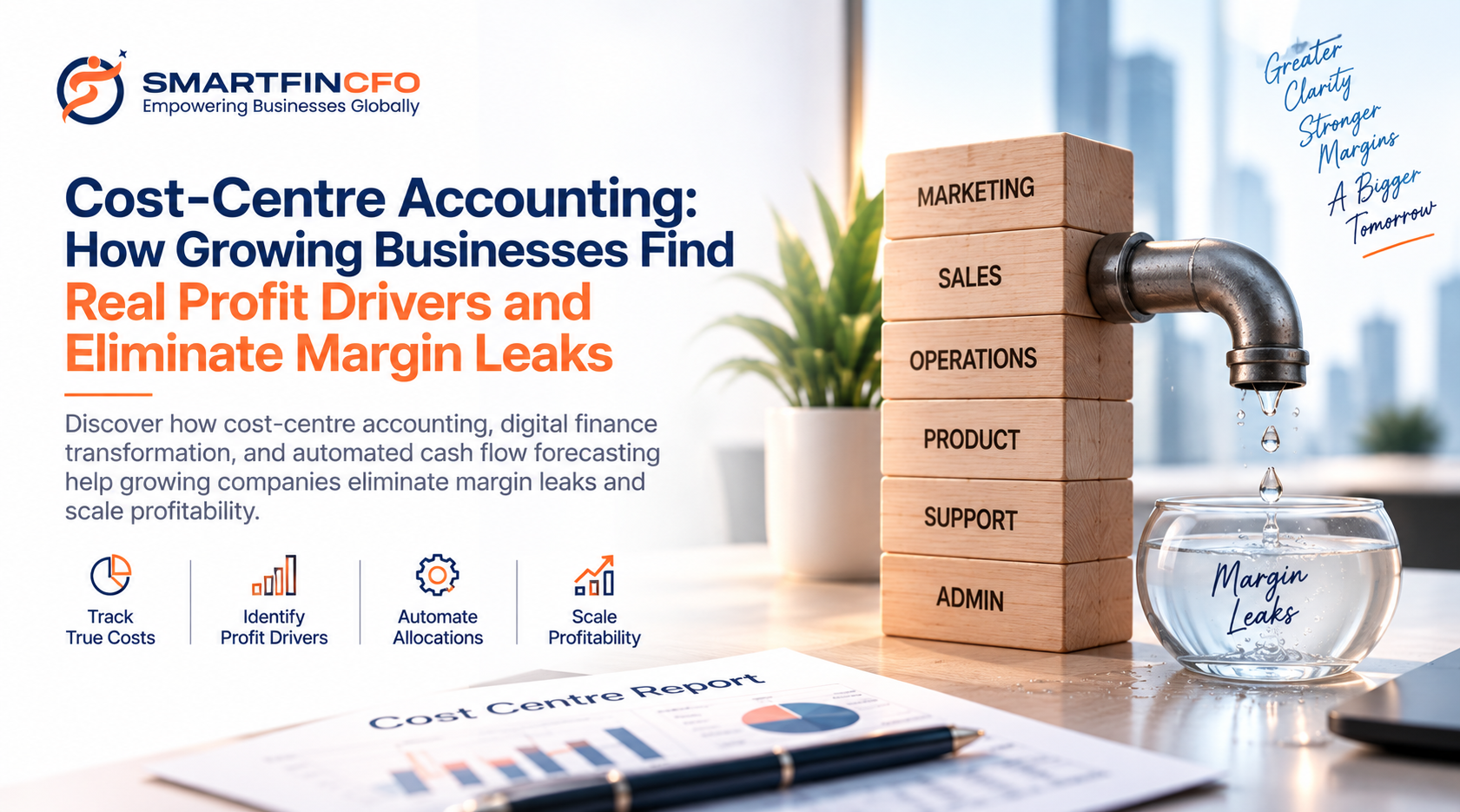
When a business scales from 10M and beyond, top-line revenue often masks underlying operational inefficiencies. A company can appear outwardly prosperous while quietly bleeding cash across underperforming service lines, bloated administrative departments, or mispriced product tiers. Without granular financial visibility, leadership is forced to manage via high-level averages—a dangerous strategy that treats every department and dollar equally.
This is where cost-centre accounting becomes essential. By segmenting your organization into distinct operational units and tracking direct and indirect expenditures against specific outputs, cost-centre accounting reveals true unit economics and uncovers margin leaks before they threaten solvency.
To build a resilient enterprise, founders and finance leaders must pair structural cost-centre design with modern finance transformation, shifting the accounting function from a reactive bookkeeping chore into an automated intelligence engine.

What Is Cost-Centre Accounting?
A cost centre is any organizational unit, department, or project that incurs expenses without directly generating revenue on its own. Classic examples include human resources, legal, IT infrastructure, research and development, and customer support.
In contrast, a profit centre generates both revenue and direct costs (e.g., specific regional sales divisions, digital product lines, or consulting practices).
Cost-centre accounting is the practice of tracking, assigning, and analyzing expenditures by distinct organizational units rather than lumping them into generic general ledger accounts like "Software Subscriptions" or "Payroll."
Why Aggregate P&Ls Deceive Growing Companies
A consolidated Profit & Loss (P&L) statement gives a macro view of enterprise health, but it routinely hides critical vulnerabilities:
- Subsidized Inefficiency: A high-margin flagship offering may conceal the fact that two newly launched service lines are operating at a net loss.
- Phantom Overhead: Shared overhead (such as executive leadership, cloud hosting, and workspace) is frequently misallocated, distorting true gross margins.
- Uncontrolled SaaS & Vendor Creep: Decentralized software purchases and vendor retainers compound across departments without accountability.
- Inaccurate Pricing Models: Without precise cost-per-department data, businesses underprice client engagements and complex enterprise deliverables.
Core Pillars of a Resilient Cost-Centre Framework
To move from aggregate financial chaos to granular profitability control, high-growth organizations structure their finance architecture across four core pillars:
┌────────────────────────────────────────────────────────┐
│            Granular Cost Allocation Matrix             │
├──────────────────────────┬─────────────────────────────┤
│ Direct Cost Assignment   │ Traceable to specific units │
├──────────────────────────┼─────────────────────────────┤
│ Activity-Based Drivers   │ Headcount, hours, data/usage│
├──────────────────────────┼─────────────────────────────┤
│ Overhead Absorption      │ Rule-based shared pools     │
└──────────────────────────┴─────────────────────────────┘
1. Direct Cost Tagging
Every incoming invoice, contractor disbursement, and software license must carry a metadata tag linking it to an owner, a cost centre code, and an operational initiative at the point of entry.
2. Activity-Based Cost Allocation
Shared resources—such as centralized engineering, legal review, or executive management—should not be arbitrarily divided. Instead, allocate shared costs based on measurable operational drivers: logged hours, server compute cycles, headcount proportion, or processed ticket volumes.
3. Real-Time Variance Tracking
Establish monthly budget baselines for each department. Implement automated alerts that flag departmental spending variances exceeding ±5% against operating plans, allowing leadership to intervene during the billing cycle rather than 30 days after the month closes.
4. Contribution Margin Analysis
Calculate departmental contribution margins to evaluate how efficiently each business line covers the company’s fixed structural overhead.
The Role of Automation in Accounting and Digital Finance Transformation
Historically, running granular cost-centre accounting required an army of bookkeepers manually tagging ledger lines and reconciling spreadsheets. In modern enterprises, the digital transformation in finance has completely altered this dynamic.
How Accounting and Automation Eliminate Manual Friction
Implementing automation in accounting turns routine transaction management into a touchless, high-precision workflow. Rather than manually inputting receipts and invoices, contemporary automation accounting platforms leverage optical character recognition (OCR), machine learning anomaly detection, and automated approval matrices.
Key areas where accounting and automation drive immediate return on investment include:
- Automated AP Ingestion & Tagging: AI parsers read vendor invoices, match them against purchase orders, and automatically apply the appropriate cost-centre code.
- Disbursement Approval Workflows: Multi-tier authorization rules route expenditures based on cost-centre thresholds before disbursements occur.
- Continuous Reconciliation: Bank feeds, merchant gateways, and sub-ledgers reconcile daily, eliminating the end-of-month scramble.
This broad digital finance transformation does not replace human strategic judgment; rather, it elevates finance professionals. As routine data entry is automated, talent shifts toward high-impact analysis, driving demand for specialized finance transformation jobs where professionals build resilient financial infrastructure, manage data pipelines, and design capital allocation models.
Connecting Cost Centres to Cash Flow Forecasting
Understanding departmental costs is only half the battle. To ensure longevity, cost-centre data must feed directly into liquidity management. Without dynamic cash forecasting, a company can be profitable on an accrual basis while facing a sudden liquidity crisis.
Cash Flow Forecasting Example: 13-Week Rolling Horizon
A standard example of cash flow forecasting demonstrates how departmental spending patterns directly impact near-term solvency. Below is a simplified operational layout illustrating how cost-centre disbursements roll into net cash flow:

| Operational Line Item | Week 1 ($) | Week 2 ($) | Week 3 ($) | Week 4 ($) | Week 5 ($) |
|---|---|---|---|---|---|
| Beginning Cash Balance | 250,000 | 285,000 | 240,000 | 210,000 | 275,000 |
| Operating Cash Inflows | |||||
| Customer Collections (AR) | 90,000 | 45,000 | 60,000 | 140,000 | 85,000 |
| Other Receipts | 5,000 | 0 | 0 | 0 | 5,000 |
| Total Cash Inflows | 95,000 | 45,000 | 60,000 | 140,000 | 90,000 |
| Cost-Centre Disbursements (Outflows) | |||||
| CC-101: Engineering & Product | (25,000) | (35,000) | (20,000) | (20,000) | (40,000) |
| CC-102: Sales & Marketing | (18,000) | (22,000) | (35,000) | (15,000) | (20,000) |
| CC-103: Client Operations | (12,000) | (15,000) | (15,000) | (18,000) | (15,000) |
| CC-104: G&A, Legal & Cloud Infra | (5,000) | (18,000) | (20,000) | (22,000) | (10,000) |
| Total Cash Outflows | (60,000) | (90,000) | (90,000) | (75,000) | (85,000) |
| Net Weekly Cash Flow | +35,000 | (45,000) | (30,000) | +65,000 | +5,000 |
| Ending Cash Balance | 285,000 | 240,000 | 210,000 | 275,000 | 280,000 |
In this cash flow forecasting example, Week 2 and Week 3 experience net negative cash burns due to marketing campaign launches and vendor software renewals. By tracking these expenses by individual cost centre, the executive team can precisely identify which department drove the variance and calibrate payment terms accordingly.
Building Beyond the Cash Flow Forecasting Excel Template
Many early-stage businesses begin tracking liquidity using a downloadable cash flow forecasting excel template or a customized cash flow forecasting template excel workbook. While an Excel model provides an intuitive starting point, static spreadsheets present notable limitations as transaction volumes multiply:
- Manual Error Vulnerability: Broken formulas, unlinked tabs, and accidental overwrites introduce hidden risk.
- Lagging Data: Spreadsheets rely on periodic manual exports, creating reporting delays.
- Siloed Departmental Inputs: Gathering budget estimates from department heads via email attachments creates version-control chaos.
Modern transformation finance strategies migrate organizations from static spreadsheets to dynamic, cloud-connected cash forecasting engines. These tools automatically synchronize bank balances, Accounts Receivable ageing, and Accounts Payable commitments into real-time rolling projections.
Practical Steps to Implement Cost-Centre Accounting
Establishing departmental clarity requires an organized rollout. Follow this structured roadmap to institute cost-centre discipline across your enterprise:
Step 1: Standardize Your Chart of Accounts (COA)
Restructure your general ledger so that natural expense accounts (e.g., Salaries, Software, Travel) are cleanly separated from departmental dimensions. Avoid creating redundant accounts like "Marketing Software" and "Engineering Software"—instead, maintain a single "Software" account tagged with distinct Cost Centre IDs.
Step 2: Establish Departmental Ownership
Assign a specific budget owner to every cost centre. When department leaders are directly accountable for their unit's variance reports, discretionary spending decreases and expense scrutiny becomes built-in.
Step 3: Implement Automated AP and Spend Controls
Deploy automated procurement and expense management tools. Require pre-approval for expenses over a defined threshold, ensuring every dollar is allocated to a pre-authorized cost centre before invoices are approved.
Step 4: Institute a Recurring Decision Rhythm
Do not let financial reports sit unread in an inbox. Establish a monthly Management Information System (MIS) review cadence where business leaders evaluate:
- Actual vs. Budgeted spend by cost centre
- Unit margin contributions by product line
- Days Sales Outstanding (DSO) and collection efficiency
- 13-week forward-looking runway stress tests
Moving from Financial Chaos to Complete Operational Control
As organizations expand across multiple markets and business units, financial complexity grows exponentially. Relying on blended margins and end-of-year tax returns leaves founders operating in the dark.
By implementing cost-centre accounting, embracing the digital transformation in finance industry best practices, and automating routine accounting workflows, growing businesses gain the operational clarity needed to eliminate margin leaks, protect working capital, and scale with sustainable profitability.
Whether through structured internal systems or working alongside Virtual CFO leaders, upgrading your financial operating system turns finance into your primary engine for strategic decision-making.