
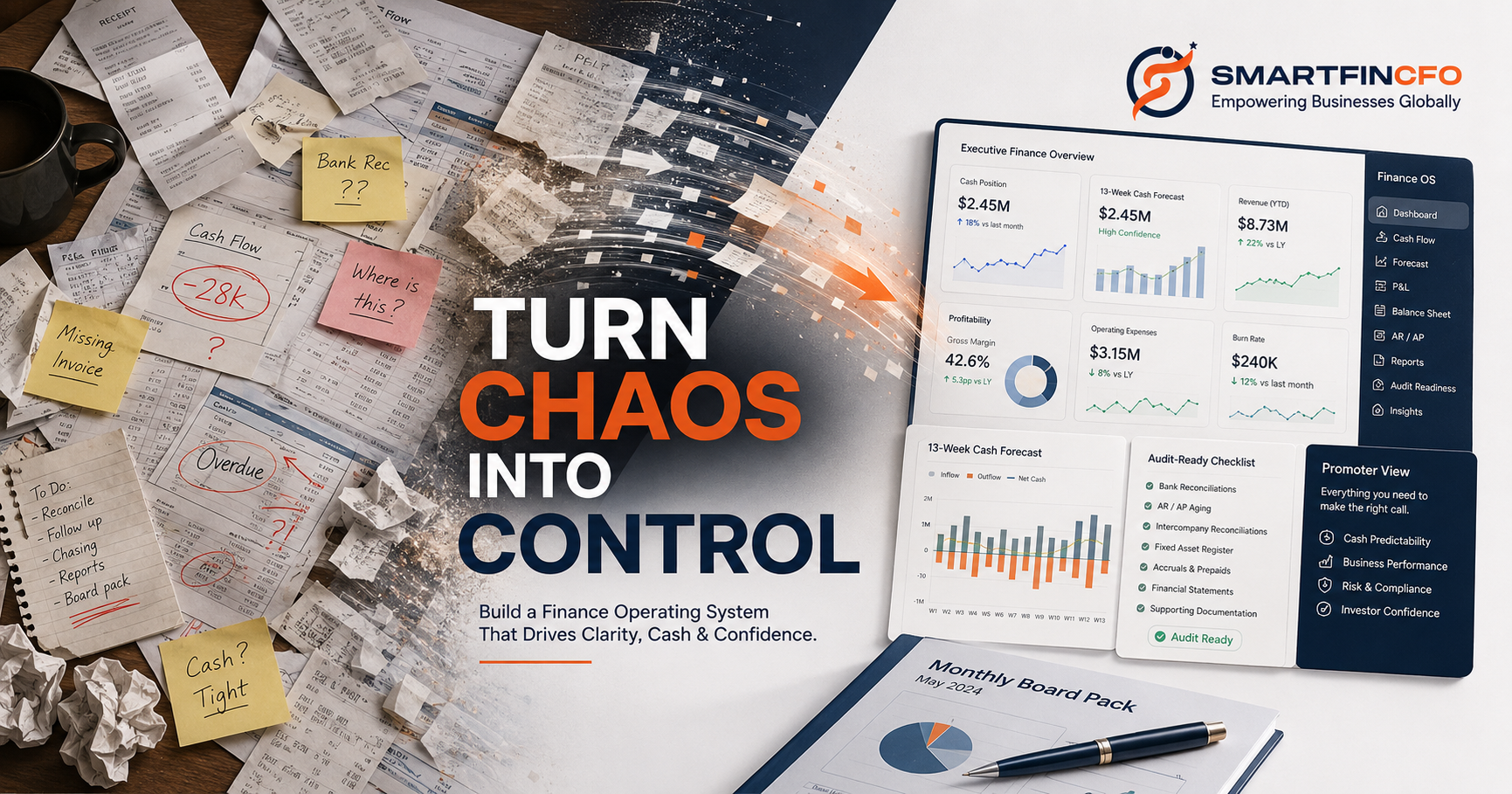
Every successful startup or growing MSME eventually hits a critical inflection point. It is not always a wall of customer acquisition or product development—it is often a wall built of financial chaos. In the early days of a business, founders typically rely on basic bookkeeping, focusing primarily on tax compliance and ensuring the bank balance remains above zero. However, as the company scales, operations become exponentially more complex. Transaction volumes increase, payroll expands, and multiple departments begin to generate their own fragmented costs.
Suddenly, the reactive accounting methods that once sufficed are no longer enough. This transition period is where many founders find themselves flying blind. Without a structured finance operating system, business leaders are forced to make high-stakes decisions based on fragmented data, gut feelings, or reports that are weeks out of date.
Moving from this state of financial chaos to complete operational control requires a fundamental shift in how finance is viewed: not as a back-office reporting chore, but as the central nervous system for executive decision-making. In this article, we will explore how growing businesses can implement a structured transformation that replaces opaque reporting with predictable cash flow, clear profitability, and strategic investor-readiness.
Understanding the Core Problem: The Progression of Financial Chaos
For many founders and promoters, the realization that their financial operations are broken does not happen overnight. It typically unfolds as a steady progression of friction points that eventually disrupt the core business. Recognizing these symptoms is the first step toward building a robust solution.
Fragmented Bookkeeping and Unreliable Books
It usually starts with disjointed accounting practices. Bookkeeping is done in silos, perhaps split between in-house staff and an external accountant who only looks at the numbers once a quarter. This fragmentation leads to unreliable books. Reconciliations are delayed, expenses are miscategorized, and revenue recognition does not match operational reality. When the foundation is flawed, every subsequent financial process is built on shaky ground.
Opaque Reporting and Delayed Insights
Because the underlying data is unreliable, management reporting becomes a frustrating, time-consuming endeavor. Founders ask for a simple Profit & Loss (P&L) statement or a balance sheet, and it takes weeks to generate. By the time the reports are finally delivered, the information is historical and irrelevant to the immediate challenges the business is facing today. Opaque reporting prevents leaders from understanding their true margins, unit economics, or department-level spending.
Liquidity Friction and Cash Flow Blind Spots
Perhaps the most dangerous symptom of financial chaos is liquidity friction. A company can be highly profitable on paper but still run out of cash. Without clear visibility into accounts receivable (AR) and accounts payable (AP), founders cannot accurately predict their working capital needs. Uncontrolled spend and delayed collections create a massive cash flow blind spot, forcing the business into reactive, last-minute scrambles to make payroll or pay crucial suppliers.
Reactive Leadership and Stalled Growth
Ultimately, this progression leads to reactive leadership. When founders cannot trust their numbers, they cannot forecast accurately or plan for growth. Strategic initiatives like geographical expansion, new product launches, or fundraising are delayed or executed poorly because the executive team lacks confidence in their financial footing. Instead of steering the ship, leaders spend their time putting out financial fires.
The Paradigm Shift: Building a Finance Operating System
To break free from this cycle, businesses must change their perspective. Finance is not just about logging historical transactions for tax authorities; it is about looking forward and providing actionable intelligence. This requires building a comprehensive Finance Operating System.
The Role of Accounting Automation
Technology is a critical enabler in this transformation. Modern accounting platforms integrated with AI-driven tools can automate the mundane aspects of bookkeeping. Automation handles transaction anomaly detection, invoice processing, and bank reconciliations, drastically reducing human error and administrative burden. However, automation is only part of the solution; software alone cannot replace strategic judgment.
Human-Led Expertise: The Virtual CFO
The most effective finance operating systems pair automation with human-led senior finance leadership. A Virtual CFO provides the oversight necessary to interpret the data, set up structured controls, and guide the business through complex scenarios. By leveraging a Virtual CFO, growing businesses gain access to top-tier financial strategy without the overhead of a full-time, in-house CFO.
A Single, Joined-Up Financial View
The goal of this paradigm shift is to create a single, joined-up financial view. This means connecting operational metrics to financial outcomes, ensuring that every department—from sales to HR to operations—understands how their actions impact the company's bottom line. When finance operates as an integrated decision engine, the business can move with agility and confidence.
Phase 1: Establishing a Financial Foundation
The journey from chaos to control typically begins with a rigorous effort to establish a solid financial baseline. This phase is about stopping the bleeding, cleaning up historical data, and putting basic governance structures in place.
Centralizing Governance and the Finance Command Centre
The first step is establishing a shared operating environment, often referred to as a cloud finance vault. This central repository ensures that all financial documents, contracts, and records are securely stored and easily accessible. Concurrently, a clear accountability matrix must be defined. By clearly delineating roles and Key Result Areas (KRAs), the business establishes a structured, weekly finance operating rhythm.
Achieving Accounting Integrity
Once the governance structure is in place, the focus shifts to the data itself. This involves a comprehensive review of the books to identify and correct past errors. Regular bank reconciliations, ledger scrutiny, and transaction anomaly detection are implemented. A strict monthly closing checklist is adopted to ensure that the books are closed efficiently and accurately at the end of each period.
Transitioning to Audit-Ready Books
The culmination of this foundational phase is a set of books that are completely audit-ready. This does not just mean they comply with local tax laws (whether in the UAE, India, the US, or across borders); it means they reflect the true financial health of the business. Audit-ready books are the prerequisite for any meaningful management reporting or strategic planning.
Phase 2: Gaining Operational Control and Cash Predictability
With a solid foundation in place, the business can now bridge the gap between raw data and actionable intelligence, focusing heavily on working capital, department-level accountability, and overall profitability.
Management Information Systems (MIS)
Operational control relies on decision-ready reporting. This is where standardized Management Information Systems (MIS) come into play. Instead of waiting weeks for basic reports, management receives timely, accurate P&L statements, balance sheets, and cash flow reports. These documents are summarized into executive formats that highlight key variances and track performance against the budget.
Mastering Working Capital and Liquidity
Cash is the lifeblood of any growing business. In this phase, strict controls are placed on Accounts Receivable (AR) and Accounts Payable (AP). Days Sales Outstanding (DSO) and Days Payable Outstanding (DPO) are closely monitored. An aggressive but professional AR follow-up process is implemented to accelerate collections, while AP is managed to optimize cash retention without damaging supplier relationships. The result is a dramatic improvement in cash predictability, allowing founders to sleep soundly knowing their runway is secure.
Profitability by Department and Unit Economics
As a business scales, it is no longer sufficient to look at overall profitability. Leaders must understand which products, services, or departments are driving margins and which are draining resources. By implementing cost centers and conducting deep dives into unit economics, a business can allocate capital far more effectively. Budget versus actual variance analysis becomes a routine exercise, ensuring that spending remains aligned with strategic goals.
Phase 3: Building the Executive Decision System
The final stage of the transformation elevates the finance function from operational management to strategic foresight. This is where the founder or promoter gains an "executive decision system" or Promoter Cockpit—a consolidated dashboard that provides total visibility into the business's trajectory.
Forward-Looking Analytics: The 13-Week Cash Forecast
While historical reporting is essential, true executive control requires looking ahead. The implementation of a rolling 13-week cash flow forecast is a game-changer for MSMEs and startups. This tool simulates cash inflows and outflows over the next quarter, identifying potential shortfalls long before they occur. It allows leaders to model various scenarios—such as a delayed client payment or an unexpected market shift—and plan accordingly.
KPI Scorecards and Cross-Functional Dashboards
To build a data-driven culture, financial awareness must permeate the entire organization. Cross-functional dashboards and executive KPI scorecards are deployed to give department heads visibility into their financial performance. Sales, HR, and Operations teams are empowered with data that shows how their specific metrics affect the company's financial health. This alignment ensures that everyone is pulling in the same direction.
Strategic Moves: Valuation, Fundraising, and Expansion
With the Promoter Cockpit fully operational, the business is now fundamentally "investor-ready." The financial data is pristine, operations are controlled, and future projections are based on solid models rather than optimistic guesses. Whether the goal is raising venture capital, preparing for an SME-IPO, negotiating a business sale, or planning a cross-border expansion, the founder is armed with five-year dynamic projections, cap table models, and precise valuation scenarios. They can negotiate from a position of absolute strength.
The Role of a Virtual CFO in Sustaining the Transformation
Building a finance operating system is an incredible achievement, but maintaining and leveraging it requires ongoing discipline. This is where the long-term value of a Virtual CFO shines through the "Plan–Review–Advise" rhythm.
Plan: Seeing the Road Ahead
A Virtual CFO continuously engages in financial planning, budgeting, and forecasting. They help the founder translate long-term business goals into concrete financial targets. By maintaining visibility into the road ahead, the business can proactively navigate market shifts and seize growth opportunities.
Review: Knowing What Changed
The review motion involves the ongoing oversight of accounting performance, compliance, and decision-ready reporting. The Virtual CFO acts as a critical sounding board, analyzing the month-end MIS packs, conducting variance analysis, and ensuring that the financial foundation remains uncompromised. This includes managing complex cross-border compliances and providing robust audit support.
Advise: Making the Next Move
Perhaps the most crucial element is strategic advice. With clean data and operational control secured, the Virtual CFO advises on the company's next big moves. Should you hire that new executive team? Is it the right time to open a new facility? How should the next funding round be structured? The Virtual CFO provides the executive-level guidance needed to make these decisions with total confidence.
The Cost of Inaction: Why Delaying Transformation is Risky
Some founders hesitate to invest in a comprehensive finance overhaul, believing they can get by with their current patchwork of bookkeepers and reactive spreadsheets for a little longer. However, the cost of inaction is steep. Uncontrolled cash flow can lead to sudden insolvency, even for highly profitable companies. Poor financial records can completely derail due diligence processes, costing founders millions in valuation during a fundraising round or exit event.
Furthermore, the mental toll on a founder who is constantly worried about financial blind spots cannot be overstated. By proactively building a decision-ready financial system, leaders protect their equity, their peace of mind, and their company's future.
Taking the First Step Toward Financial Clarity
Moving from financial chaos to complete operational control is not a mystical process; it is a structured, deliberate transformation. For startups, MSMEs, and ambitious founders, upgrading from reactive bookkeeping to an integrated finance operating system is one of the highest-leverage investments they can make.
By focusing on a strong financial foundation, mastering operational and working capital controls, and ultimately building an executive decision system, businesses can unlock their true growth potential. Supported by accounting automation and the strategic oversight of a Virtual CFO, business leaders no longer have to guess what their numbers mean—they can use them to confidently chart the course ahead.