
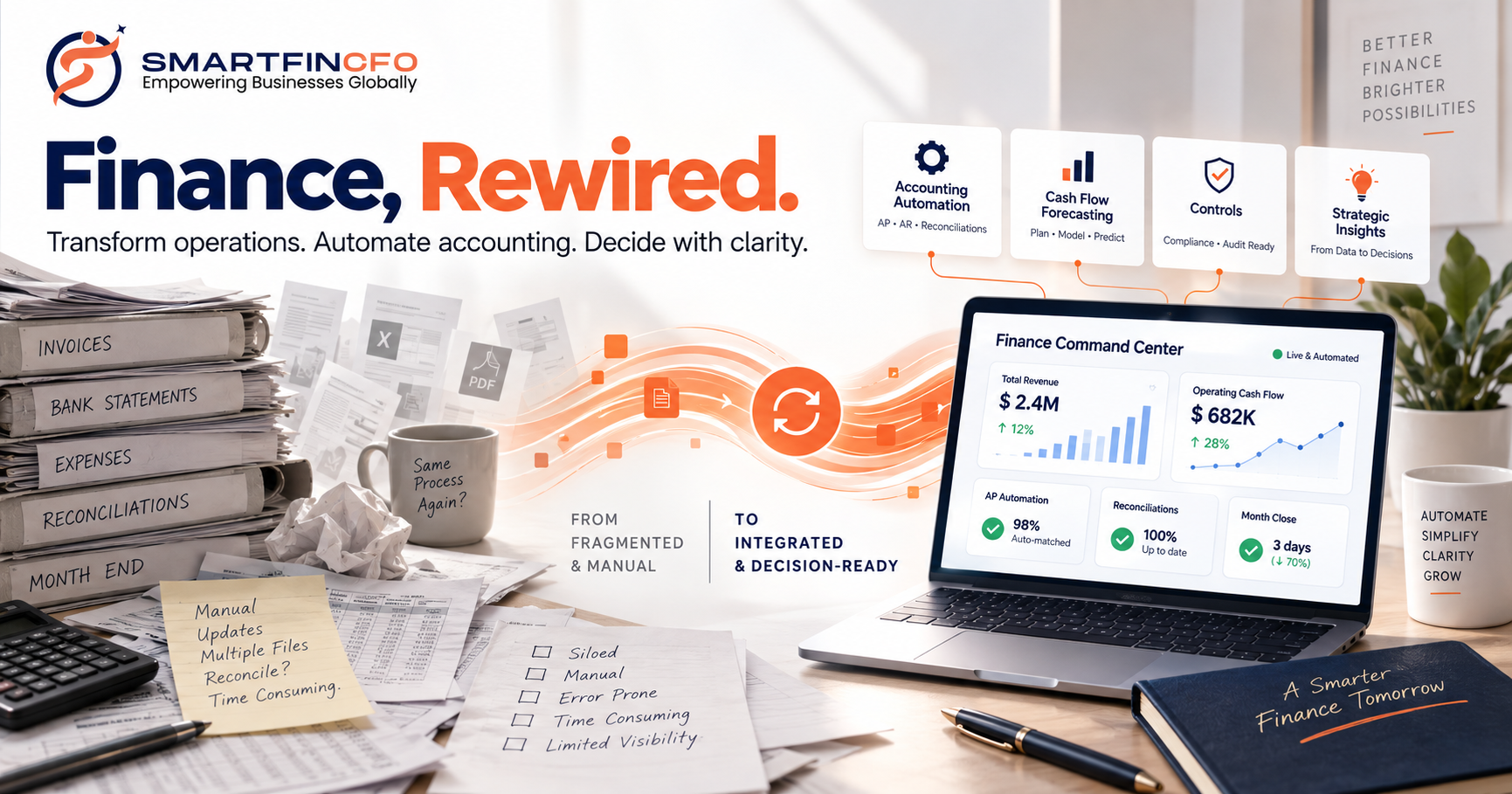
For decades, finance departments operated primarily as historical record-keepers. Accountants spent endless hours manually keying invoices, reconciling bank statements line-by-line, and wrestling with brittle spreadsheets to produce month-end financial packs two to three weeks after the books closed. In today's volatile economic environment, relying on lagging indicators and manual workflows is no longer just inefficient—it is an existential business risk.
Modern high-growth enterprises, startups, and mid-market companies are undergoing a fundamental shift: finance transformation. By fusing human strategic expertise with cutting-edge technology, leadership teams are turning their finance function from a reactive cost center into an agile engine for growth and risk mitigation.
This guide breaks down the core pillars of digital finance transformation, explores how automation in accounting operates in practice, and provides actionable frameworks—including a practical cash flow forecasting model—to modernize your financial operations.

Understanding Finance Transformation: Beyond Just Software
Many business leaders confuse software adoption with comprehensive transformation. Implementing an enterprise ERP or subscribing to modern cloud tools is only one tactical piece of the puzzle. True transformation finance encompasses a holistic redesign of people, processes, governance, and data architecture.
At its core, a complete financial operating system operates across six interdependent layers:
- Governance & Controls: Establishing clear Key Result Areas (KRAs), cloud vaults, access protocols, and weekly operational review cadences.
- Accounting Integrity: Clean ledger structures, real-time transaction reconciliation, rigorous closing checklists, and audit-ready books.
- Management Information Systems (MIS): Timely P&L statements, balance sheets, cash flow tracking, and executive summaries delivered within days of month-end.
- Working Capital & Liquidity Management: Active monitoring of Days Sales Outstanding (DSO), Days Payable Outstanding (DPO), Cash Conversion Cycles (CCC), and rolling cash runways.
- Profitability & Cost Control: Departmental profitability, cost center accounting, unit economics, and deep budget-versus-actual variance analysis.
- Executive Intelligence & Advisory: Forward-looking scenario modeling, KPI scorecards, dynamic multi-year projections, and investor-grade reporting.
When these layers work in harmony, leadership shifts from asking "What happened last quarter?" to answering "What strategic levers should we pull next week to protect margins and accelerate growth?"
The Role of Automation in Accounting and Finance Operations
The convergence of accounting and automation has dismantled repetitive, low-value administrative burdens. By automating routine ledger operations, finance professionals can redirect their cognitive capacity toward strategic problem-solving, capital allocation, and risk management.
+-------------------------------------------------------------------------+
|                    MODERN AUTOMATED FINANCE PIPELINE                    |
|                                                                         |
|  [ Ingestion ]        [ Processing ]        [ Intelligence & Action ]   |
|  - Bank Feeds         - Rule Engine         - Real-Time Dashboards      |
|  - OCR Invoices   ->  - Anomaly Audit   ->  - Variance Alerts           |
|  - Payroll Sync       - Auto-Reconcile      - 13-Week Cash Forecast     |
+-------------------------------------------------------------------------+
1. Ingestion and Optical Character Recognition (OCR)
Modern automation systems pull invoices, receipts, and bank transaction feeds directly into tools like QuickBooks Online, Zoho Books, or Tally via API connections and OCR parsers. Invoices are automatically matched against purchase orders, eliminating manual entry errors.
2. Intelligent Reconciliation and Anomaly Detection
Rules-based engines and AI audit assistants flag transaction anomalies, missing tax codes, duplicate vendor bills, and mismatched ledger entries in real time. Instead of discovering discrepancies during annual audits, exceptions are resolved instantly.
3. Automated Collections and Payables Workflows
Accounts receivable workflows trigger automated payment reminders, parsing ageing debtor buckets and alerting relationship managers when accounts enter high-risk thresholds. Accounts payable systems route invoices through predetermined approval matrices before triggering programmatic batch payouts.
4. Executive Summarization and Variance Alerts
Rather than manually calculating percentage variances, digital workflows dynamically surface root-cause explanations when departmental expenses exceed predefined budget thresholds, sending executive summaries directly to stakeholders.
Digital Transformation in Finance Industry: Market Drivers & Evolution
The broader wave of digital transformation in finance is reshaping how businesses compete and how institutions allocate capital. Several macroeconomic forces are accelerating this shift across the industry:
- Margin Compression: Rising operational costs require real-time visibility into unit economics and product-level gross margins.
- Compressed Decision Windows: Fast-moving competitive landscapes mean quarterly reports are outdated before they reach board members.
- Data Proliferation: Modern tech stacks generate massive transactional data. Without unified data pipelines, organizations suffer from conflicting operational silos.
- Regulatory Complexity: Dynamic compliance standards, statutory documentation, and tax reporting demand continuous compliance tracking rather than year-end panics.
How Finance Transformation Jobs Are Evolving
The shift toward automation does not eliminate human talent; it elevates it. The landscape of finance transformation jobs has evolved from transactional bookkeepers and data entry clerks to strategic business partners. Emerging finance roles focus on:
- Finance Systems Architects: Designing integrated software stacks and automated data pipelines across CRM, ERP, and payment gateways.
- FP&A Analytics Leaders: Building predictive scenario models, assessing capital expenditure returns, and running runway stress simulations.
- Strategic Virtual CFOs: Partnering with founders to drive fundraising readiness, M&A due diligence, and valuation optimization.
Mastering Liquidity: Building a Robust Cash Flow Forecasting Engine
While accrual accounting tracks revenue and profitability, liquidity determines business survival. A profitable enterprise can still fail if cash inflows and outflows are poorly synchronized.
One of the highest-leverage outcomes of digital finance transformation is implementing a 13-week rolling cash forecast. Unlike static annual budgets, a rolling forecast dynamically incorporates actual weekly receivables, payroll cycles, and tax obligations to project cash reserves over a 90-day horizon.
Practical Example of Cash Flow Forecasting
Consider a growing enterprise with recurring software revenue, professional service billings, and fixed operational overhead. Below is a structured snapshot illustrating how weekly receipts and disbursements roll into an updated net cash position:
| Line Item | Week 1 ($) | Week 2 ($) | Week 3 ($) | Week 4 ($) |
|---|---|---|---|---|
| Beginning Cash Balance | 150,000 | 172,000 | 138,000 | 161,000 |
| Cash Inflows (Collections) | ||||
| Recurring Client Retainers | 45,000 | 12,000 | 50,000 | 15,000 |
| Project Milestone Invoices | 10,000 | 5,000 | 18,000 | 25,000 |
| Total Cash Inflows | 55,000 | 17,000 | 68,000 | 40,000 |
| Cash Outflows (Disbursements) | ||||
| Team Payroll & Contractors | 18,000 | 35,000 | 18,000 | 38,000 |
| Cloud Infrastructure & Software | 4,000 | 1,000 | 6,000 | 2,000 |
| Vendor Payables & Rent | 6,000 | 12,000 | 15,000 | 8,000 |
| Statutory Tax & Compliance | 5,000 | 3,000 | 6,000 | 4,000 |
| Total Cash Outflows | 33,000 | 51,000 | 45,000 | 52,000 |
| Net Cash Flow for Period | +22,000 | -34,000 | +23,000 | -12,000 |
| Ending Cash Balance | 172,000 | 138,000 | 161,000 | 149,000 |
In this example, Week 2 experiences a net cash burn of $34,000 due to mid-month payroll and vendor obligations. Because the team tracks rolling cash positions in advance, they can strategically adjust discretionary vendor payments or accelerate receivable collections before liquidity dips below reserve thresholds.
Building Your Own Cash Flow Forecasting Excel Template
If you are setting up an internal model using a cash flow forecasting Excel template, structure your workbook around four dedicated tabs:
- Assumptions & Control Tab: Input payment terms, average debtor collection delay (DSO), standard payroll dates, and minimum cash reserve thresholds.
- Accounts Receivable (AR) Sub-ledger: Extract current open invoices from your accounting platform and apply realistic collection probabilities based on ageing categories (e.g., 0–30 days at 95%, 31–60 days at 80%, 61+ days at 50%).
- Accounts Payable (AP) Schedule: Map committed purchase orders, recurring software subscriptions, and scheduled lease obligations by due date.
- 13-Week Master Rolling Sheet: Link inputs into the standard formula:
When connected with automated bank feeds and ageing parsers, your template transitions from a static historical document into an operational runway simulator.
Step-by-Step Implementation Framework for Financial Modernization
Transforming financial operations requires a disciplined, phased roadmap. Executing changes sequentially ensures minimal disruption to daily operations while delivering fast time-to-value.
+-----------------------------------------------------------------------------------------+
|                         4-STAGE FINANCE TRANSFORMATION ROADMAP                          |
|                                                                                         |
|  Phase 1: Diagnostic   Phase 2: Standardization   Phase 3: Automation   Phase 4: Cadence|
|  - Audit Chart of Accts - Closing Checklists      - Automated Ingestion - Weekly Reviews|
|  - Map Inefficiencies  - Role Accountability      - 13-Week Forecast    - KPI Cockpits  |
+-----------------------------------------------------------------------------------------+
Phase 1: Operational Diagnostic & Hygiene Audit
- Review chart of accounts for consistent granularity across cost centers and revenue streams.
- Identify manual touchpoints, bottleneck approvals, and data entry redundancies.
- Clear historical reconciliation backlogs and aged uncollected balances.
Phase 2: Standardization & Governance
- Document standard operating procedures (SOPs) for invoice approvals, travel expenses, and vendor onboarding.
- Implement strict month-end closing checklists to ensure books close within 5 business days.
- Clarify team accountability matrices and establish secure document repositories.
Phase 3: Systems Integration & Automation Layer
- Connect core cloud accounting platforms with banking rails, payroll software, and invoicing portals.
- Deploy rules-based bank reconciliation and automated invoice OCR capture.
- Configure dynamic 13-week rolling cash forecasts and automated variance alert engines.
Phase 4: Executive Decision Cadence
- Establish a structured weekly review cadence to analyze liquidity, receivables ageing, and operational burn.
- Deliver monthly Board and Leadership packs detailing margin contribution, unit economics, and dynamic projections.
- Leverage strategic CFO advisory to guide capital allocation, fundraising, or growth initiatives.

Combining Modern Automation with Expert Human Leadership
A critical lesson learned by scaling organizations is that software alone does not run finance. Autonomous tools excel at pattern recognition, data ingestion, and alerting, but they cannot replace seasoned commercial judgment.
The most resilient organizations adopt a hybrid model: pairing automated, cloud-native infrastructure with experienced Virtual CFO advisory. This combination gives founders and executives institutional-grade financial intelligence, robust compliance, and strategic foresight—without the overhead of a bloated in-house department.
Whether preparing for institutional fundraising, navigating an SME-IPO, or strengthening working capital resilience, modernizing your finance architecture is the single most impactful investment you can make in your business's long-term enterprise value.