
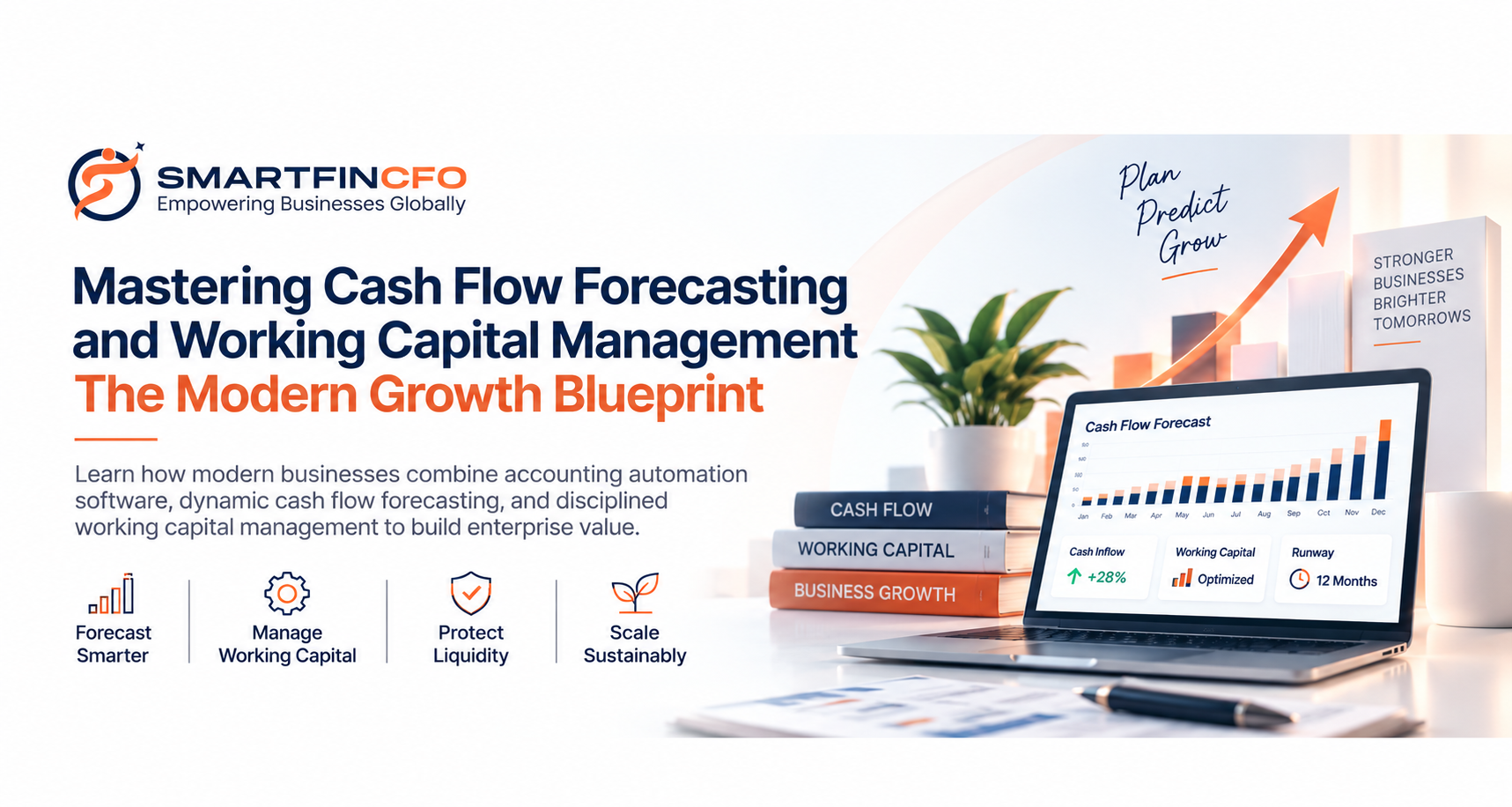
From Burn Rate to Enterprise Value: The Strategic Guide to Working Capital and Cash Flow Forecasting
For scaling startups, mid-market enterprises, and ambitious founders, top-line revenue growth can be deceptive. A company can report record billings and healthy operating margins on its income statement while simultaneously edging toward a liquidity crisis. The root cause is almost never a lack of market demand; rather, it is operational friction—trapped balance sheet liquidity, protracted collection cycles, unmanaged vendor terms, and an absence of forward-looking financial visibility.
To navigate rapid expansion and macroeconomic shifts, executive teams must master two tightly coupled disciplines: cash flow management and forecasting and strategic working capital management. When powered by modern accounting automation software and senior financial guidance, these functions transform bookkeeping from a backward-looking compliance exercise into an agile operating system for executive decision-making.
The Strategic Imperative: Beyond Rearview-Mirror Bookkeeping
Traditional compliance accounting answers a single retrospective question: What happened last month? While statutory compliance, monthly ledger closes, and historical reconciliations remain vital financial hygiene, they do not provide actionable guidance on forward-looking business decisions. They cannot confirm whether your enterprise can absorb a 60-day enterprise receivable delay, self-fund a critical product rollout, or execute an aggressive hiring ramp next quarter.
Forecasting cash flow shifts an organization's perspective from the rearview mirror to the windshield. Rather than simply logging debits and credits after payments clear, forward-looking models simulate future bank balances across multiple operational scenarios.
+---------------------------------------------------------------------+
|                       FINANCIAL PERSPECTIVES                        |
|                                                                     |
|  Historical Accounting  --->  "What happened last quarter?"        |
|  Cash Flow Forecasting  --->  "Where will our cash balance sit      |
|                                in 30, 60, and 90 days?"             |
|  Working Capital Control -->  "How efficiently do operations        |
|                                convert assets into liquid cash?"    |
+---------------------------------------------------------------------+
A disciplined approach to the forecasting of cash flow delivers four decisive advantages:
- Dynamic Runway Transparency: Knowing your exact liquidity trajectory under conservative, expected, and stretch revenue conditions prevents emergency bridge rounds and punitive credit facilities.
- Intentional Capital Allocation: Identifying cash surpluses 60 to 90 days ahead empowers management to negotiate early-payment supplier discounts, reinvest in high-ROI acquisition channels, or expand physical inventory without risking payroll.
- Proactive Variance Analysis: Regular forecasting exposes subtle margin compression, scope creep, and payment slippages well before they materialize as operational emergencies.
- Investor and Lender Credibility: Capital allocators, banking partners, and institutional investors expect transparent, real-time liquidity visibility before extending senior debt or equity capital.
Mastering the Engine: Working Capital Management
Accurate cash flow and forecasting depends entirely on the operational mechanisms governing how capital circulates through your balance sheet. This makes the management of working capital the heartbeat of daily operations.
Working capital—traditionally calculated as Current Assets minus Current Liabilities—represents the net liquid resources required to maintain ordinary business operations. Rigorous capital working management ensures a company avoids the twin perils of illiquidity (cash starvation) and operational inefficiency (excess cash locked in slow receivables or dormant stock).
+---------------------------------------------------------------------+
|                     THE CASH CONVERSION CYCLE                       |
|                                                                     |
|       Days Sales Outstanding (DSO)                                  |
|     + Days Sales of Inventory (DSI)                                 |
|     - Days Payable Outstanding (DPO)                                |
|     ================================                                |
|     = CASH CONVERSION CYCLE (CCC)                                   |
+---------------------------------------------------------------------+
Effective management working capital strategies center on compressing the Cash Conversion Cycle (CCC) across three primary operational levers:
1. Receivables Acceleration (Reducing DSO)
Accounts receivable represent interest-free financing granted to your customers. Uncollected invoices starve core operations of working liquidity. Optimizing this pillar involves:
- Implementing strict, automated credit assessment protocols before onboarding enterprise accounts.
- Structuring milestone-based billing, retainer models, or upfront payment incentives (e.g., 2/10 Net 30 terms).
- Leveraging automated dunning sequences and integrated merchant payment links to reduce collection friction.
2. Payables Synchronization (Balancing DPO)
Strategic working management capital does not mean delaying vendor payments until relationships are damaged. Rather, it means aligning payment schedules with operational cash collections:
- Negotiating standard 45-to-60-day payment terms with key supply chain partners.
- Taking selective advantage of early-payment discounts when cash balances allow, while scheduling routine disbursements to match bi-weekly or monthly collection cycles.
- Consolidating vendor relationships to secure volume rebates and favorable billing terms.
3. Inventory and Work-in-Progress Optimization (Controlling DSI)
For inventory-holding, manufacturing, or service businesses with heavy unbilled WIP (Work in Progress), tied-up inventory directly depletes working reserves:
- Utilizing just-in-time replenishment and continuous batch-level tracking.
- Liquidating or discounting dead inventory to recover capital, even if sold at near-cost.
- Accelerating billing cycles for professional service deliverables immediately upon project milestone completion.
The Architecture of an Actionable Cash Flow Forecasting Model
Building a dependable financial model requires pairing high-level strategic horizons with granular short-term visibility. A single static spreadsheet updated once a year is insufficient for high-growth operations.
The 13-Week Rolling Cash Flow Framework
While 12-month and 5-year models serve strategic capital planning and board meetings, the 13-week rolling cash flow forecast is the gold standard for operational liquidity control. Covering an exact calendar quarter, it captures weekly cash reality with precision.
+---------------------------------------------------------------------+
|                13-WEEK ROLLING FORECAST ARCHITECTURE                |
|                                                                     |
|  [Opening Cash Balance]                                             |
|     + Cash Inflows   (Confirmed A/R Collections, Direct Sales)       |
|     - Cash Outflows  (Payroll, Taxes, Vendor Payables, Debt)         |
|  -----------------------------------------------------------------  |
|  = [Net Operational Cash Flow]                                      |
|  + Financing / Investment Inflows & Outflows                        |
|  -----------------------------------------------------------------  |
|  = [Ending Cash Balance] (Rolls forward as next week's opening)     |
+---------------------------------------------------------------------+
To deploy a dynamic cash flow forecasting template, structure your ledger inputs into distinct categories:
- Beginning Liquid Balance: Verified cash and cash equivalents across all corporate accounts at the start of the week.
- Operating Inflows: Collections from aging accounts receivable, upfront SaaS retainers, recurring subscription billings, and cash sales, adjusted by historical collection delays.
- Operating Disbursements: Payroll commitments, benefits, statutory tax obligations (GST, TDS, payroll taxes), essential SaaS tooling, and critical vendor invoices.
- Non-Operating Outflows: Scheduled debt service, equipment leases, capex disbursements, and owner distributions.
- Ending Cash Position & Buffer Metrics: The projected net closing cash balance compared against your predefined minimum operational liquidity buffer.
Each week, finance teams conduct variance analyses comparing forecasted figures with actual cleared bank transactions. This continuous feedback loop refines collection assumptions and increases model accuracy over time.
Accelerating Visibility with Accounting Software Automation
Historically, running rolling forecasts and tracking working capital required financial analysts to spend dozens of hours manually downloading CSV files, sanitizing ledger entries, and copying numbers between disconnected spreadsheets. This manual approach is slow, error-prone, and obsolete before the analysis reaches leadership.
Modern finance operations rely on specialized software for cash flow forecasting integrated directly into accounting software automation infrastructure.
+---------------------------------------------------------------------+
|                    MODERN AUTOMATED FINANCE STACK                   |
|                                                                     |
|  [ Banking & Invoicing ]  --->  [ Accounting Automation Software ]  |
|   (Stripe, Bank Feeds)            (Ledger Reconciliation, OCR)      |
|                                                |                    |
|                                                v                    |
|                                 [ Cash Flow Forecasting Software ]  |
|                                   (Scenario Modeling, 13-Wk View)   |
|                                                |                    |
|                                                v                    |
|                                  [ Executive Decision Cockpit ]     |
|                                    (KPIs, Working Capital Ratios)   |
+---------------------------------------------------------------------+
How Automation Unlocks Strategic Advantage
- Automated Bank Feeds and Reconciliation: Modern accounting automation software matches bank transactions against open invoices in real time, ensuring receivables and payables balances stay constantly up to date.
- AI-Powered OCR Expense Capture: Invoices and receipts are scanned, categorized, and scheduled for payment automatically, eliminating data entry delays.
- Live Scenario Simulation: Dedicated cash flow forecasting software empowers leadership to test "what-if" scenarios instantly: What if our enterprise accounts delay payment by 30 days? How does a 15% drop in conversion impact hiring capacity?
- Automated Milestone Alerts: System warnings notify management when receivables exceed credit limits or when bank balances dip below required operating thresholds.
Technology alone, however, cannot replace experienced financial leadership. Software provides the computational engine; senior finance leaders interpret the trends, set policy, and guide capital allocation.
From Cash Control to Enterprise Value: The Valuation Connection
Many founders view working capital management and cash flow forecasting purely as defensive measures designed to avoid insolvency. In reality, they are primary drivers of enterprise value.
When engaging independent business valuation services or preparing for institutional equity funding, strategic acquisitions, or public market listings, potential buyers and valuation experts look far beyond historical accounting earnings. They examine the quality, predictability, and capital efficiency of your operating cash flows.
+---------------------------------------------------------------------+
|                 THE PATH TO MULTIPLE EXPANSION                      |
|                                                                     |
|  Strong Cash Flow Controls  -->  Lower Perceived Operational Risk   |
|  Compressed Working Capital -->  Higher Free Cash Flow to Firm      |
|  Automated Finance Systems  -->  Clean Diligence & Fast Closing     |
|                                         |                           |
|                                         v                           |
|                           PREMIUM ENTERPRISE VALUATION              |
+---------------------------------------------------------------------+
1. Expansion of Free Cash Flow to Firm (FCFF)
In Discounted Cash Flow (DCF) valuation models, enterprise value is determined by the present value of future free cash flows. When a business compresses its cash conversion cycle, it frees up cash that would otherwise sit trapped on the balance sheet. Higher free cash flow translates directly into higher discounted valuation outputs.
2. Lower Weighted Average Cost of Capital (WACC)
Businesses demonstrating predictable cash flow predictability, automated financial governance, and low receivables volatility present a lower risk profile to lenders and investors. This reduced operational risk lowers the company's cost of capital and discount rates, driving valuation multiples upward.
3. Accelerated Due Diligence Readiness
Enterprises backed by clean automated ledgers, dynamic forecasting models, and clear working capital controls navigate M&A and venture due diligence rapidly. Institutional buyers discount transactions or demand aggressive indemnities when working capital is erratic or unpredictable.
Practical Roadmap: Building a Resilient Cash Operating System
Transforming financial chaos into complete operational control requires a deliberate, phased implementation roadmap:
+---------------------------------------------------------------------+
|                     4-STAGE IMPLEMENTATION ROADMAP                  |
|                                                                     |
|  Stage 1: Foundation      Clean ledger, eliminate reconciliation    |
|                           backlogs, automate bank feeds.            |
|                                                                     |
|  Stage 2: Cash Engine     Establish a rolling 13-week cash          |
|                           forecast and baseline working capital.    |
|                                                                     |
|  Stage 3: Optimization    Compress DSO, balance vendor DPO,         |
|                           and deploy scenario modeling software.    |
|                                                                     |
|  Stage 4: Value Creation  Link cash intelligence directly to        |
|                           strategic planning and valuation.         |
+---------------------------------------------------------------------+
Step 1: Clean Up the Ledger Foundation
Accurate forecasting is impossible with un-reconciled ledgers or stale data. Eliminate bookkeeping backlogs, connect live bank feeds via accounting software automation, and standardize your Chart of Accounts across operational departments.
Step 2: Establish Minimum Cash Reserves and Working Capital Baselines
Define an absolute minimum liquidity threshold (typically 2 to 4 months of fixed operating overhead). Calculate your existing Cash Conversion Cycle (DSO, DPO, DSI) to establish baseline working capital benchmarks.
Step 3: Implement a Weekly 13-Week Cash Review Rhythm
Deploy a dynamic forecasting template and schedule a mandatory weekly 30-minute cash review with executive leadership. Review variances between forecasted collections and actual bank settlements to refine future models.
Step 4: Integrate Scenario Planning and Advisory Leadership
Transition from manual spreadsheets to dedicated software for cash flow forecasting. Model growth scenarios, evaluate capital expenditure timing, and engage a Virtual CFO to translate cash data into strategic business expansion, debt structuring, and long-term valuation planning.
Transforming Liquidity Management into a Strategic Moat
Cash flow is the lifeblood of business growth, but liquidity is never accidental. It is the direct outcome of disciplined working capital management, predictive cash forecasting, and automated financial infrastructure.
By moving away from backward-looking bookkeeping and establishing an integrated financial operating system, founders and executive teams gain complete visibility over their capital. With automated tools handling routine data capture and senior finance leadership steering strategic modeling, your business transforms everyday cash control into sustainable growth, operational resilience, and enduring enterprise value.