
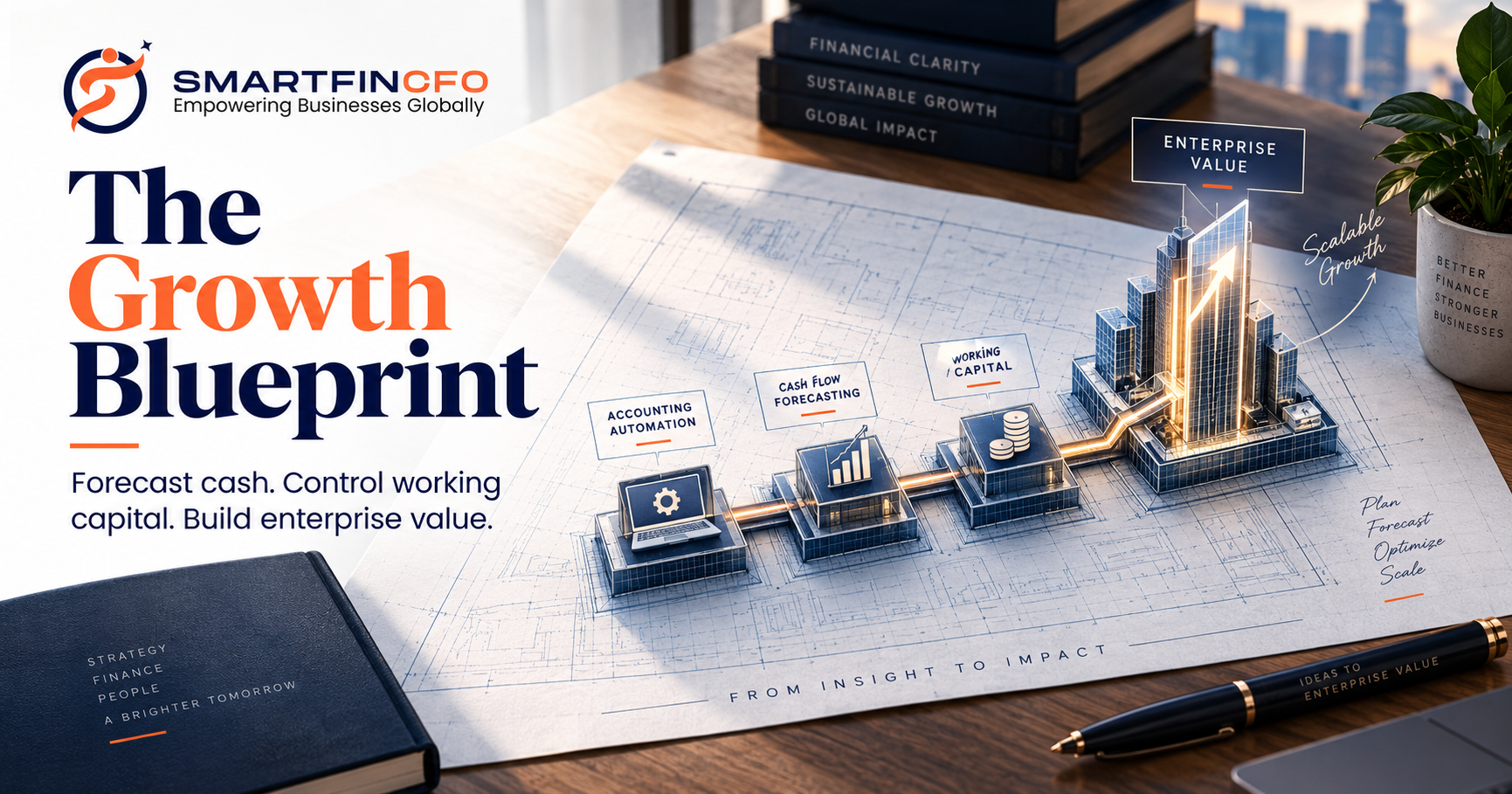
For growing enterprises, mid-market companies, and ambitious founders, top-line revenue expansion and accrual-based profitability do not guarantee financial health. A company can show impressive gross margins and record paper profits while simultaneously experiencing an acute liquidity crisis. When customer receivables stall, inventory ties up working capital, and vendor obligations fall due, even the most promising business can run out of cash.
Navigating modern operational challenges requires shifting from fragmented, backward-looking bookkeeping to a resilient financial operating architecture. By combining accounting automation software, strategic working capital management, and rigorous cash flow management and forecasting, leadership teams build the predictability needed to navigate volatility. Furthermore, companies with clear financial governance, shortened cash cycles, and reliable projections consistently unlock superior multiples when seeking growth capital, strategic financing, or professional business valuation services.
The Real-Time Foundation: Modern Accounting Software Automation
Traditional financial reporting is inherently retrospective. In conventional setups, leadership receives income statements and balance sheets two to four weeks after month-end close. By the time discrepancies or cash leaks are noticed, operational conditions have already evolved.
Deploying modern accounting software automation establishes an audit-ready, real-time data spine that serves as the single source of truth for executive decision-making.
+-----------------------+     +------------------------+     +-------------------------+
|   Data Ingestion      | --> | Automated Reconciliation| --> | Real-Time MIS & Reports |
| (Banks, Invoices, POS)|     |   & Rules Engine       |     | (Dashboards & Runway)   |
+-----------------------+     +------------------------+     +-------------------------+
1. Eliminating Reporting Latency
Automation bridges transaction engines, corporate bank feeds, payment gateways, and enterprise general ledgers. Automated categorization rules, digital receipt parsing, and scheduled multi-bank reconciliations compress the financial closing cycle from weeks into hours.
2. Standardized Chart of Accounts and Granular Cost Centers
Automated accounting ensures uniform expense attribution across business units, geographies, and client accounts. Enforcing consistent taxonomy prevents misallocations, enabling management information systems (MIS) to deliver granular unit economics and direct margin visibility.
3. Compliance Integrity and Audit Readiness
Regulatory withholdings, indirect tax calculations, and statutory schedules are tracked continuously. Having an automated, transparent audit trail significantly de-risks operations during third-party statutory audits, compliance reviews, and financial due diligence.
Strategic Control: The Management of Working Capital
Effective management of working capital balances operational liquidity with capital efficiency. When leadership overlooks the proactive management of working capital, internal cash gets trapped in uncollected customer balances or stagnant inventory, forcing businesses to depend on expensive short-term debt.
The Mechanics of the Cash Conversion Cycle (CCC)
The fundamental metric governing management working capital is the Cash Conversion Cycle, which tracks how many days it takes for capital invested in operations to return as cash in the bank:
Where:
- Days Sales Outstanding (DSO): Average days required to convert credit sales into cleared funds.
- Days Inventory Outstanding (DIO): Average time stock remains tied up before being sold.
- Days Payable Outstanding (DPO): Average duration taken to settle trade payables with suppliers.
  +--------------------------------------------------------------+
  |                Operating Cycle (DSO + DIO)                   |
  +--------------------------------------------------------------+
  [Purchase Material] ----------> [Sell Goods] ----------> [Collect Cash]
           |                                                     |
           | <--- DPO ---> |                                     |
    [Vendor Payment]                                             |
           | <------------- Cash Conversion Cycle -------------> |
Practical Levers Across the Working Capital Spectrum
Optimizing capital working management requires targeted operational workflows across receivables, payables, and inventory:
| Operating Pillar | Common Operational Bottleneck | High-Impact Optimization Strategy |
|---|---|---|
| Accounts Receivable (AR) | Ambiguous credit terms, billing delays, lack of follow-up rhythm | Milestone-based billing, automated payment reminders, structured credit approval thresholds, and strict collection escalation matrices. |
| Accounts Payable (AP) | Ad-hoc disbursements, missed early-payment discounts, duplicate invoices | Centralized approval workflows, automated payment scheduling aligned with cash inflows, and disciplined supplier negotiation for optimal terms. |
| Inventory / WIP | Over-purchasing based on guesswork, obsolete inventory accumulation | Data-driven reorder levels, SKU rationalization, active supplier lead-time management, and liquidation of non-moving inventory. |
Disciplined working management capital ensures that operational growth funds itself organically rather than burning through emergency reserves.
Predictive Intelligence: Dynamic Cash Flow Forecasting
While working capital optimization improves cash velocity, forecasting cash flow provides visibility into future solvency, runway, and investment timing. Static annual budgets quickly become obsolete in dynamic markets; high-performing organizations rely instead on rolling, probabilistic cash flow and forecasting systems.
+-------------------------+     +--------------------------+     +-------------------------+
| Live Accounting & Bank  | --> | Rolling 13-Week Dynamic  | --> | Scenario Stress Testing |
| Automated Feeds         |     | Cash Flow Forecast Engine|     | (Base, Growth, Stress)  |
+-------------------------+     +--------------------------+     +-------------------------+
1. Direct vs. Indirect Forecasting Models
- Direct Method (Short-Term Operational View): Tracks daily and weekly cash receipts and disbursements directly from bank flows. This is essential for 13-week operational runway management, vendor disbursement planning, and payroll scheduling.
- Indirect Method (Medium- to Long-Term Strategic View): Starts with projected net income and adjusts for non-cash expenses, working capital shifts, capital expenditures (CapEx), and financing activities. This framework supports multi-year strategic roadmaps.
2. Transitioning from Static Spreadsheets to Cash Flow Forecasting Software
Many organizations begin managing liquidity using an internal cash flow forecasting template. While spreadsheet templates are valuable for early-stage baseline modeling, growing businesses face version control errors, manual data entry friction, and broken formulas.
Modern cash flow forecasting software and dedicated software for cash flow forecasting solve these bottlenecks by connecting live accounting software automation directly with bank APIs. These platforms enable finance teams to:
- Automatically update actuals against projected cash balances.
- Run granular variance analyses comparing forecast vs. actual cash positions.
- Stress-test scenarios, such as extended debtor delays, sudden supply chain cost spikes, or revenue fluctuations.
3. Setting Up a Disciplined 13-Week Rolling Cash Flow Cadence
A weekly liquidity rhythm ensures proactive executive control:
- Monday: Review bank reconciliations and opening cash across all operating accounts.
- Tuesday: Assess projected weekly receivables and trigger automated collection workflows.
- Wednesday: Gate vendor payment approvals based on prioritized disbursement thresholds.
- Thursday: Run scenario analyses for upcoming payroll, tax, and debt servicing milestones.
- Friday: Lock the rolling 13-week forecast, analyze variances from the previous week, and update executive scorecards.
Connecting Working Capital Discipline to Business Valuation Services
Cash flow predictability and working capital efficiency do not merely prevent liquidity crunches—they directly expand enterprise value. During formal business valuation services, strategic acquirers, investment banks, and institutional investors scrutinize the quality of earnings and cash conversion speed.
  +-------------------------------------------------------------+
  |                Enterprise Valuation Expansion               |
  +-------------------------------------------------------------+
  | 1. High Free Cash Flow Conversion (Low Working Capital Drag)|
  | 2. Predictable, Data-Backed Cash Flow Projections          |
  | 3. Clean, Automated Financials & Audit Trails               |
  +-------------------------------------------------------------+
                                 |
                                 v
           [ Lower Risk Premium + Higher Valuation Multiple ]
1. Discounted Cash Flow (DCF) Mechanics
In standard DCF modeling, enterprise value is determined by discounting expected future Free Cash Flow to Firm (FCFF):
When capital working management is inefficient, absorbs large sums of cash, directly reducing FCFF. Conversely, shortening receivables collection and optimizing inventory frees cash, yielding higher valuation outputs.
2. De-Risking the Cost of Capital
In valuation methodologies, predictable financial operations reduce perceived risk, lowering the discount rate (Weighted Average Cost of Capital, or WACC). Companies that demonstrate robust forecasting of cash flow paired with clean, automated books receive lower risk penalties and command premium market multiples.
Practical Implementation: A 4-Step Action Blueprint
To build an integrated liquidity and working capital engine, finance leaders and business promoters should execute the following transformation steps:
Step 1: Cleanse & Automate  --> Step 2: Establish Working Capital Controls
Step 3: Deploy Rolling Forecasts --> Step 4: Executive Governance Cadence
- Cleanse Ledger Data & Implement Automation: Eliminate manual entry backlogs by deploying accounting automation software across bank feeds, billing, and AP approvals.
- Establish Working Capital Guardrails: Implement formal credit assessment policies, automate milestone billing, set minimum inventory thresholds, and enforce weekly payment schedules.
- Deploy a Dynamic Cash Flow Engine: Implement specialized software for cash flow forecasting or an institutional-grade cash flow forecasting template to maintain continuous 13-week visibility.
- Instituting Executive Finance Governance: Align leadership around a weekly cash review pack that surfaces DSO, DPO, CCC, and variance trends alongside standard P&L reports.
Conclusion: Building Financial Resilience
Mastering cash flow and working capital is the defining difference between businesses that merely survive and those that achieve durable, scalable growth. By establishing dependable accounting software automation, enforcing rigorous management of working capital, and maintaining dynamic forecasting cash flow systems, business leaders protect liquidity, eliminate operational blind spots, and maximize long-term enterprise worth.